1. Motivation & Research

Structured by coursework requirements: The Why, The Gap, The Stakeholders.

The Why

Modern society faces a silent crisis: mental health. Data reveals that young adults (18-24) suffer the highest depression risk, exacerbated by prolonged working hours (over 10 hours daily increases risk by 23%) [1], indicating a massive unmet demand for accessible relief. Concurrently, the "Running Craze" is exploding. According to the data released by China Athletics Association in 2025 [2], more than 7 million participants engage in the marathon events that have been included, driven by the public's recognition of running as a potent stress reliever.

However, existing apps often focus solely on tracking metrics and performance, failing to address the psychological barriers to exercise. Our app wants to bridge this gap by merging scientific mental health support with the communal energy of running, offering a playful solution for a stressed generation seeking solace on the pavement.

The Gap

Academic research and commercial products both show value, but neither fully supports emotional needs during running.

Academic Research

  • [3] Oswald et al. (2020) A scoping review of the relationship between running and mental health.
  • [4] Roeh et al. (2020) Marathon running improves mood and negative affect.
  • [5] Keating et al. (2019) Impact of a structured, group-based running programme on complex mood disorders.
  • [6] Borrajo et al. (2024) Negative self-talk in runners.

What They Did Well

  • Existing studies consistently show that running has significant positive effects on mental health, such as reducing stress, anxiety, and depression [3][4].
  • Research explores both short-term and long-term emotional benefits of running across different populations [3][5].
  • Some studies provide insights into psychological processes during running, such as motivation and self-talk [6].

What They Missed

  • Lack of personalized solutions tailored to users' real-time emotional states [3][5].
  • Limited focus on user experience and interaction during running activities [4].
  • No translation of research findings into interactive digital systems or applications [3][6].

Commercial Products

  • [7] Keep App.
  • [8] Sigma Fitness App.
  • [9] Joyrun Running App.
  • [10] Nike Run Club App.

What They Did Well

  • Provide comprehensive and precise tracking of running data, such as distance, pace, and heartbeat rate [7][8][9][10].
  • Incorporate motivational features like virtual medals, challenges, and social forums [7][9][10].
  • Some applications introduce AI to analyze each user's physical condition and personalize the most appropriate training schedule [7][9].

What They Missed

  • Lack of monitoring of users' mental well-being [7][8][9][10].
  • Lack of decompression-related functions such as breathing training [7][8][9][10].
  • Do not provide enough emotional support and companionship for stressed users [8].

Identified Gap

Although both academic research and commercial products highlight the benefits of running, there is a clear gap in integrating emotional awareness with interactive and user-centered design.

Academic studies focus on outcomes rather than user interaction, while commercial applications emphasize performance tracking or gamification. Neither effectively supports users' emotional needs during running.

Therefore, there is an opportunity to design a playful and human-centric system that provides real-time emotional feedback, personalized running experiences, and interactive support, bridging the gap between mental health research and practical applications.
The Stakeholders

Primary and secondary users with distinct personas.

Primary User

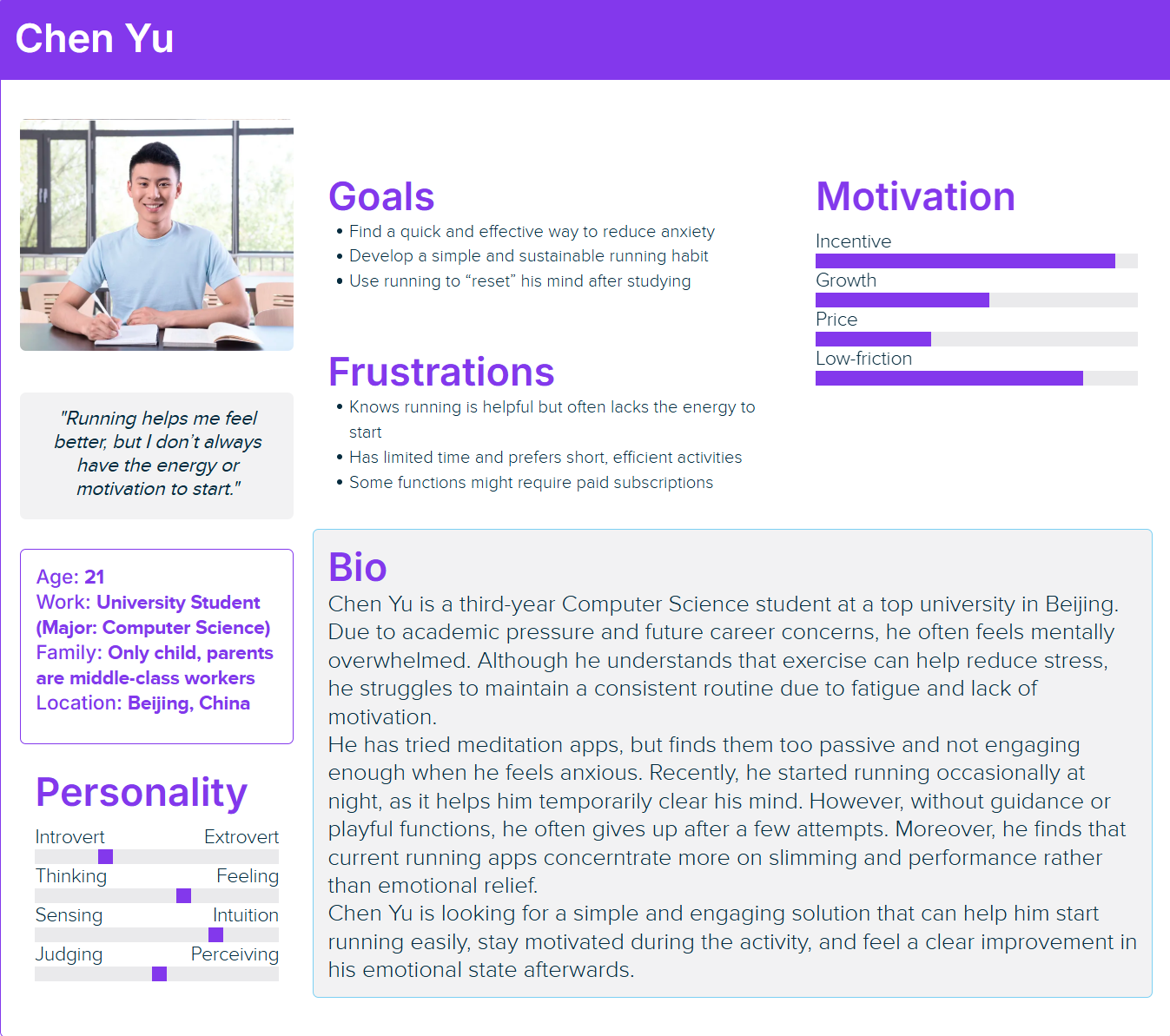
Chen Yu

Primary user persona board for Chen Yu
Secondary User

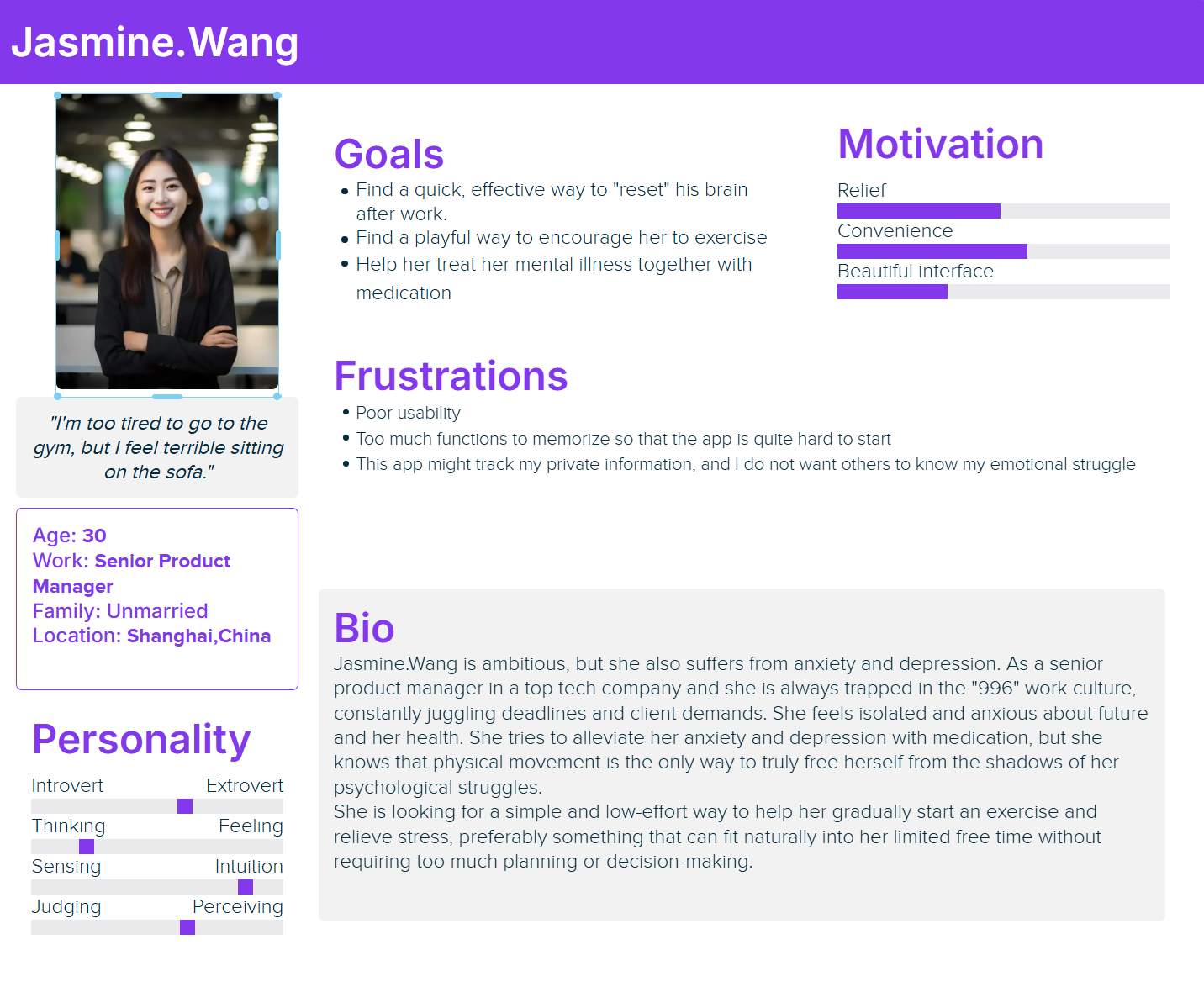
Jasmine Wang

Secondary user persona board for Jasmine Wang

Reference List

  • [1] China.org.cn. (2025). Blue Book Report: 2024 National Mental Health Development Report.
  • [2] China Athletics Association. (2025). 2024 China Road Running Blue Book.
  • [3] Oswald, F., Campbell, J., Williamson, C., Richards, J., & Kelly, P. (2020). A scoping review of the relationship between running and mental health. International Journal of Environmental Research and Public Health, 17(15), 5361.
  • [4] Roeh, A., Lembeck, M., Papazova, I., Pross, B., Hansbauer, M., Schoenfeld, J., Haller, B., Halle, M., Falkai, P., Scherr, J., & Hasan, A. (2020). Marathon running improves mood and negative affect. Journal of Psychiatric Research, 130, 254-259. https://doi.org/10.1016/j.jpsychires.2020.08.005
  • [5] Keating, L.E., Becker, S., McCabe, K., Whattam, J., Garrick, L., Frey, B.N., Sassi, R.B., & McKinnon, M.C. (2019). Impact of a structured, group-based running programme on clinical, cognitive and social function in youth and adults with complex mood disorders: A 12-week pilot study. BMJ Open Sport & Exercise Medicine, 5(1), e000521. https://doi.org/10.1136/bmjsem-2019-000521
  • [6] Borrajo, E., Calvete, E., & Urquijo, I. (2024). Negative self-talk in runners: Emotional intelligence and perceived stress as explanatory factors. Psychology of Sport and Exercise, 70, 102545. https://doi.org/10.1016/j.psychsport.2023.102545
  • [7] CalorieTech (n.d.) Keep App. Available at: https://www.calorietech.com/appIntro (Accessed: 24 March 2026).
  • [8] SigmaApp (n.d.) Sigma Fitness App. Available at: https://www.sigmaapp.com/ (Accessed: 24 March 2026).
  • [9] Joyrun (n.d.) Joyrun Running App. Available at: https://www.thejoyrun.com/ (Accessed: 24 March 2026).
  • [10] Nike (n.d.) Nike Run Club App. Available at: https://www.nike.com/nrc-app (Accessed: 24 March 2026).